EuroPick Education
University of Padova admission becomes easier to understand when you separate the process into clear stages: choosing a course, checking eligibility, submitting an application, accepting an offer, arranging funding, completing visa procedures, and enrolling. Each stage has its own documents and deadlines. Completing one stage does not automatically complete the next.
This guide explains those stages in simple English for international students, with additional guidance for applicants from India. It focuses on the 2027–28 academic year and English-taught bachelor’s and master’s degrees. Where only current-year fees or scholarship rules are available, the year is stated clearly. Use the official links beside the relevant information before making payments or booking travel.
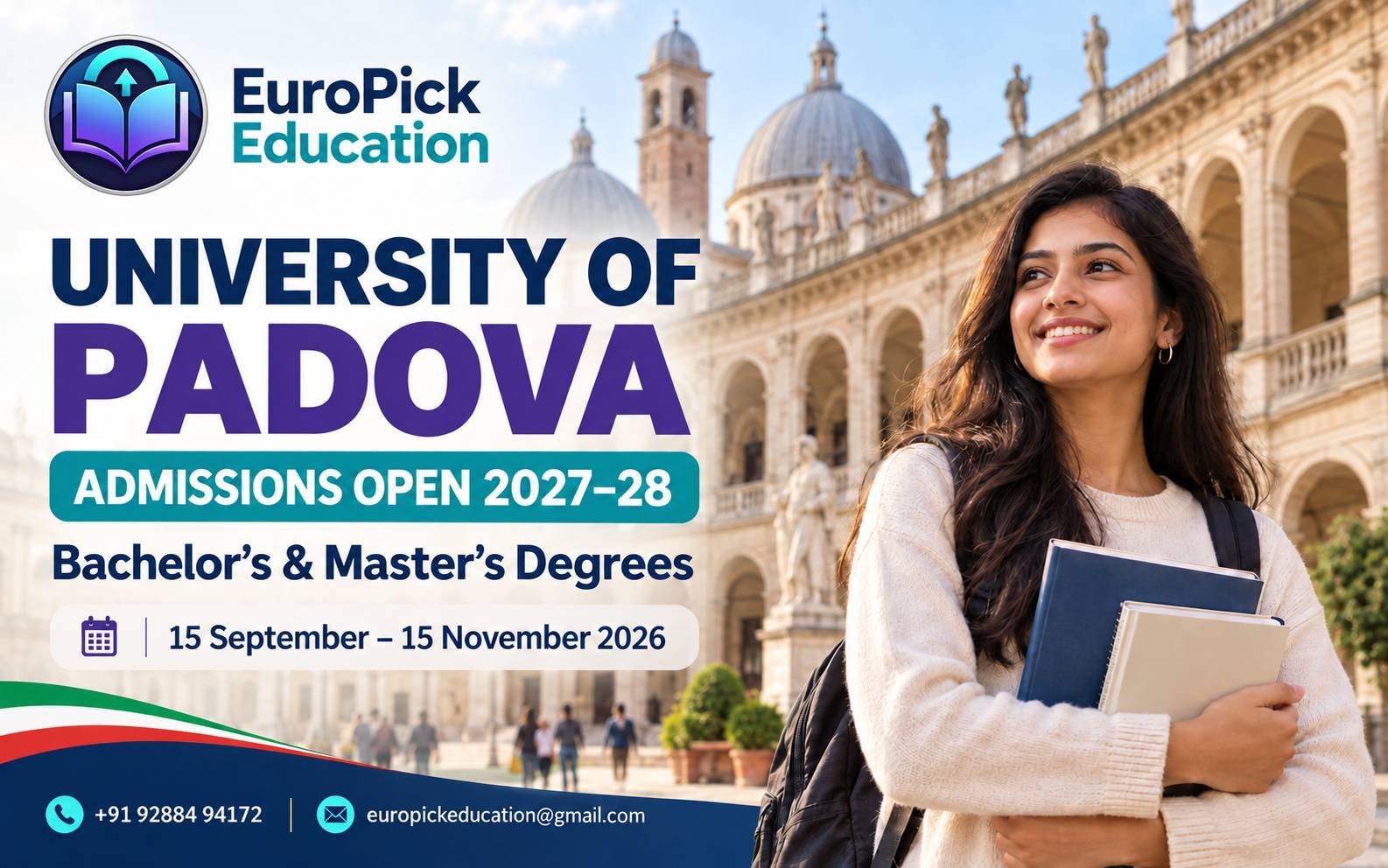
The university has announced that its first 2027–28 application round runs from 15 September to 15 November 2026 for most programmes. Your chosen course may follow a different timetable. Start with its admission notice, rather than assuming that one deadline covers the entire university. Official admission announcement
1 Understand the university and your study goal
The names University of Padua and University of Padova refer to the same institution. Padua is the English form of the city’s name; Padova is the Italian form. You will see both spellings during your research and application.
Before comparing courses, write down what you want from your degree. A school student may want a broad foundation in engineering. A graduate may want specialist training in data analysis, economics, environmental science, or psychology. These are different goals, and they require different academic preparation.
Do not choose a programme only because a social media post calls it easy to enter. Ask whether you would enjoy studying its compulsory subjects for several years. Read the modules, assessment methods, campus location, teaching format, and progression opportunities.
For a useful first exercise, divide a page into three columns: subjects you have studied, skills you can demonstrate, and subjects you want to learn. Courses that connect these columns deserve a closer look. This gives your application a clear direction and makes writing your motivation letter much easier.
2 Choose the correct degree level
A bachelor’s degree is normally the first university qualification after secondary school. A standard Italian bachelor’s usually lasts three years and carries 180 ECTS credits. A standard second-cycle master’s normally lasts two years and carries 120 ECTS credits. ECTS measures academic workload; it is not a percentage score.
There is another distinction worth understanding. A Laurea Magistrale is the standard second-cycle degree discussed throughout this article. An Italian Master universitario is a separate postgraduate qualification with its own rules. Do not assume that every course containing the word master offers the same academic progression.
Medicine and other single-cycle degrees also follow a different structure. They should not be confused with a two-year master’s entered after graduation.
When comparing options, record the official qualification title, duration, entry qualification, and degree class. If your long-term plan includes a doctorate or a regulated profession, check the recognition requirements in the country where you intend to work. A course title alone cannot answer those questions.
3 University of Padova admission dates for 2027
The following table separates confirmed announcements from dates that still require a programme-specific check. It is a planning summary, not a replacement for your admission notice.
|
Admission stage |
Date or current status |
|
First call for most 2027–28 programmes |
15 September to 15 November 2026 |
|
Later application calls |
Verify in the individual programme notice |
|
English certificate submission |
By 31 July 2027 under the current language rules |
|
Qualification completion for limited access |
General rule states 31 July; confirm the applicable year and notice |
|
Qualification completion for open access |
General rule states 31 August; confirm the applicable year and notice |
|
Padova Universitaly deadline for 2027–28 |
Not established in the reviewed sources |
|
National study visa application ceiling for 2027–28 |
31 October 2027; earlier university deadlines may apply |
|
Exact teaching start and arrival deadline |
Check the programme calendar and enrolment instructions |
Sources: admission dates, language deadline, qualification completion, and national visa timetable.
Save deadlines with the year and the stated Italian time zone. An application deadline, a test booking deadline, and a document submission deadline may fall on different days. Aim to finish early enough to correct a payment or upload problem.
Use a weekly application review while you are preparing. Choose an evening to check progress, read new messages, and update your calendar. This keeps the process manageable alongside school, university, or work.
In the first week, complete your course comparison and identify any eligibility questions. In the second, request transcripts, syllabuses, and missing certificates. Use the next stage for language preparation, written documents, and any required entrance test arrangements. This is a suggested working order, not an official university timetable.
Give every unfinished task an owner and a next action. For example, instead of writing transcript pending, record that you will contact the registrar on Monday and collect the document when notified. Specific actions are easier to follow than a long list of worries.
Ask a trusted person to review the final application for simple errors. They can compare dates, names, course titles, and attachments without changing your academic story. You should still read and approve everything yourself.
Keep one final folder containing exactly what you submitted. If the university later asks a question, you will be able to answer from the same records rather than searching through several drafts.
4 Understand application calls and applicant categories
Padova’s general guidance describes one annual intake, with teaching beginning around late September or October. Multiple application calls are selection rounds for that intake. They are not separate opportunities to begin classes in spring. Later rounds can depend on available places and applicant category. Official intake guidance
Your route depends on more than nationality. The education system that awarded your qualification, your residence status, and any relevant Italian residence permit can affect the procedure. An Indian citizen studying in Italy may not follow precisely the same route as an Indian citizen applying from India.
Read the category definitions in the current notice. Do not select a category simply because it displays a later deadline. If your circumstances are unusual, explain them to the university and request clarification before submission.
Keep that reply with your records. A short written explanation of your citizenship, country of residence, qualification system, and permit type is more useful than a general message asking whether you can apply. Clear questions help the admissions team give you a relevant answer.
5 Explore bachelor degree programmes in English
The university’s current English-language catalogue lists Animal Care, Psychological Science, Techniques and Methods in Psychological Science, Information Engineering, Italian Medieval and Renaissance Studies, Biology of Human and Environmental Health, Earth and Climate Dynamics, and Economics, Governance and Decision-Making.
It also names four proposed bachelor’s programmes for 2027–28: Management, Finance and Business Analytics; Physics for Technology; Food Safety for Global Health; and Innovative Technologies in Agriculture. These are marked as awaiting approval. They should not be presented as confirmed open courses. Official English degree catalogue
Treat the catalogue as your starting point. Then open the individual course page to check where and how teaching takes place. Some programmes or tracks may have arrangements that differ from a conventional full-time classroom course.
For example, Information Engineering is listed as a three-year English-taught bachelor’s with restricted admission. Its subjects include computing, electronics, automation, and telecommunications. A student interested only in business software should inspect the mathematics and engineering content before choosing it. Information Engineering
6 Check bachelor admission eligibility
Padova normally requires an eligible secondary qualification supported by at least twelve years of schooling. Applicants from shorter school systems may need additional recognised study. A foundation course cannot replace a missing secondary school diploma. General bachelor eligibility
For India, the 2027–28 country document lists specified Standard XII qualifications, including CBSE and CISCE qualifications with at least five subjects, alongside listed higher secondary and intermediate certificates. Read the exact entry for your awarding body. Country qualification requirements
Eligibility is only the first check. You may also need the correct school subjects, an entrance test, a language qualification, and a sufficiently strong ranking position.
Build a subject record showing the marks you obtained in relevant areas. For an engineering application, pay particular attention to mathematical preparation. For a science application, examine the required science background. These are preparation suggestions; the programme notice determines the formal requirements.
If a certificate has not yet been issued, ask your school what official provisional evidence it can provide. Do this early, especially when final board results and university document deadlines are close together.
7 Prepare for the correct bachelor entrance test
Do not book an examination using an old article. Padova announced that CEnT-S replaced the former English TOLC types I, E, and F from November 2025 for relevant English-taught bachelor’s routes. Its published explanation describes mathematics, reasoning on texts and data, physics, chemistry, and biology. The announcement quoted a €55 test fee; confirm the current CISIA charge when booking. Padova CEnT-S announcement
This does not mean every bachelor’s programme uses CEnT-S. Psychology and other courses can have separate selection arrangements. Your 2027–28 notice must identify the accepted test, score rules, test period, and submission method.
Plan backwards from the date when the university needs your valid result. A provisional score may not be the final score used for selection. Leave space for result processing and any permitted retake.
Start preparation with a diagnostic exercise, then divide your study time between weak topics and timed practice. Keep an error notebook. Record why you lost each mark: missing knowledge, a calculation mistake, misunderstood English, or poor time management. That record gives you a practical revision plan.
8 Explore master degree programmes in English
Padova offers English-taught master’s options across several subject areas. Examples include the following programmes; this is a selective starting list, not a complete count of available degrees or places.
|
Subject area |
Examples to investigate |
|
Computing |
Computer Engineering, Computer Science, Cybersecurity, Data Science |
|
Engineering |
Aerospace Engineering, Energy Engineering, Environmental Engineering, Mechatronics Engineering |
|
Business and economics |
Applied Economics, Management for Sustainable Firms, Accounting, Finance and Business Consulting |
|
Biology and biotechnology |
Molecular Biology, Medical Biotechnologies, Pharmaceutical Biotechnologies |
|
Environment and agriculture |
Sustainable Agriculture, Forest Sciences, Marine Biology |
|
Society and psychology |
Human Rights and Multi-level Governance, Local Development, Clinical, Social and Intercultural Psychology |
|
Quantitative science |
Mathematics, Physics of Data, Computational Finance |
The catalogue also marks Data Analytics and Decision Support as a proposed 2027–28 programme awaiting approval. Verify its status before including it in your final choices. Official English master’s catalogue
Do not read this list as a promise that every subject accepts every bachelor’s background. Start with academic fit, then compare selection rules, course content, and costs.
9 Compare popular master degree options properly
Computer Engineering is listed as a two-year English-taught programme with open admission subject to requirements. Its scope includes computing systems, algorithms, networks, and areas such as artificial intelligence and robotics. It deserves attention if your previous studies provide a solid computing or engineering base. Computer Engineering
Cybersecurity is also listed as a two-year English-taught programme with requirements. Its approach combines technical subjects with wider legal and organisational questions around digital security. Read the curriculum before assuming it is simply a practical hacking course. Cybersecurity
Data Science focuses on collecting, managing, and analysing data. When reviewing it, examine your preparation in mathematics, statistics, and programming against the admission requirements. Interest in artificial intelligence alone is not evidence of that preparation. Data Science
Applied Economics currently describes pathways covering digital economics, economic data analytics, and environmental economics with green finance. Compare its quantitative content with your transcript and career interests. Applied Economics
For each option, identify three compulsory modules you want to study and explain how your previous education prepares you for them. If that explanation feels difficult, investigate the course more carefully before applying.
10 Check master eligibility and Indian degree rules
Master’s applicants need an appropriate bachelor’s qualification from a recognised institution and the curricular background required by the selected programme. A degree being recognised does not automatically make it suitable for every subject. General master eligibility
The India entry in Padova’s 2027–28 document distinguishes three- or four-year honours bachelor’s degrees, specified professional bachelor’s degrees, and three-year pass/general degrees. The listed pass/general route requires an additional postgraduate bachelor’s qualification or at least a one-year master’s. It lists minimum grades of 70/100, 7/10, 5.6/8, or 2.8/4, according to the relevant scale. These are eligibility thresholds, not guaranteed admission scores. Official India requirements
Do not convert your marks with an unofficial online calculator and present the result as university-approved. Supply the original grading scale and any official conversion statement your institution issues.
If your degree title does not clearly identify whether it is honours or general, request formal clarification from the awarding institution. A college advertisement or informal teacher’s message is not a reliable substitute for an official academic record.
11 Match your transcript to the curriculum
This is one of the most useful tasks for a master’s applicant. Place the course requirements beside your university transcript and identify the evidence for each requirement.
For example, a student considering a quantitative programme could list completed modules in calculus, linear algebra, probability, statistics, and programming. Alongside each module, record its credits, teaching hours if available, grade, and syllabus reference. This is a personal preparation worksheet, not a claim that all these modules are compulsory for every programme.
Course names can be misleading. A module called Business Mathematics might cover different material at different institutions. A syllabus helps an assessor understand what you actually studied.
Do not rewrite your transcript or rename subjects to make them look more relevant. Provide authentic documents and explain the connection in the permitted application fields.
If you find a major gap, investigate it before paying. Ask whether the programme accepts your background and whether any formal additional study could help. A short online course may improve your knowledge, but it does not automatically replace required university credits. Keep those two purposes separate when planning your preparation.
12 Check English requirements and exemptions
The current language page requires at least B2 English for English-taught degrees, subject to programme regulations. It allows later certificate submission, but gives 31 July 2027 as the final deadline. Certificate validity must also satisfy the published rules. Language requirements
Examples from the current B2 certificate table are IELTS 6.0, PTE Academic 65, Cambridge B2 First 173, and Duolingo English Test 115. TOEFL thresholds depend on the test date and scoring scale. Read the complete certificate list before booking. Accepted certificates and scores
Do not assume an English-medium degree from India gives an automatic exemption. The current exemption document ties previous English-medium education to specified countries or qualifications. India is not in that country list; separately listed qualifications, such as an eligible English-taught International Baccalaureate, may have their own route. English exemption rules
Book early enough to receive results and retake the test if necessary. Also check the visa language evidence separately: university acceptance of a document does not settle every consular requirement.
13 Prepare your application documents
Padova’s general document list includes identity evidence, academic transcripts, the entry qualification if already obtained, a CV, a motivation letter, language evidence, and any course-specific documents. The application checklist can vary by programme. Documents are uploaded as PDFs; academic records must be official and in English or Italian, with official translations when required. The general guidance says legalised documents are not required for the initial application. Application document guidance
Create separate folders for identity, education, language, written application materials, and payments. Keep originals separate from working copies so that you do not accidentally upload an unfinished draft.
Open every PDF after creating it. Check that stamps, signatures, page edges, marks, and the student’s name are readable. A small file is useful only if its contents remain clear.
Use descriptive filenames, such as your surname followed by Transcript or Passport. Check that the name and date of birth match across your records. Where they differ, obtain the appropriate explanation or correction through the issuing authority. Do not edit an official scan yourself.
14 Write a clear motivation letter
A useful motivation letter explains why you are ready for this particular course. It should connect your previous study, practical experience, current interests, and future plans.
Begin with your academic direction. Then describe one or two relevant experiences in enough detail to show what you learned. A project, internship, dissertation, or substantial course assignment can provide evidence. Explain your own contribution rather than taking credit for everything a group produced.
Next, connect those experiences to specific parts of the programme. Mention modules or academic themes only after reading them. Avoid listing famous subjects simply to make the letter sound impressive.
End with a realistic explanation of how the degree fits your next step. You do not need to promise a dramatic career transformation. A focused goal, supported by your background, is more convincing.
Write the first draft in your own words. Remove claims you cannot explain in an interview. Follow the requested length and template if the programme provides one. A polished letter cannot repair missing academic eligibility, but it can help an assessor understand a suitable applicant’s purpose.
15 Prepare a useful CV and supporting evidence
Your academic CV should help a reader find relevant information quickly. Include your education, selected projects, work or internship experience, technical or research skills, language ability, and achievements that can be supported.
For each project, explain the problem, your role, the method, and the result. For example, say that you analysed a dataset using a stated method and explain what you found. Avoid a long list of software names without evidence of how you used them.
Dates should be consistent with your transcripts and employment records. Explain substantial gaps honestly when the application asks. Work, exam preparation, family responsibilities, and additional study can all be described plainly.
If references are requested, contact suitable referees early and give them the programme details. They should have enough time to prepare an informed recommendation through the required route.
Check whether the programme supplies a specific CV or statement template. Do not substitute your preferred design when a mandatory format is provided. Keep decoration limited; an academic application benefits more from readable information than from a colourful layout.
16 Register and select your programmes
For the relevant international application route, begin at the official Apply portal. Its published instructions allow up to two programme applications per academic year and say you cannot apply twice to the same programme in different calls of that year. Use one account and an email address you check regularly. Official application portal
Before selecting your choices, compare them carefully. A second choice should be a course you would genuinely attend and for which you have a credible academic match. It should not be selected merely because another student described it as easier.
Complete your personal details using your passport and official academic records. Check the country and applicant category shown by the system; a website’s automatic location guess may be wrong.
Work through the checklist for each selected programme. Keep a private list of missing items and the dates on which you expect to obtain them. Save your progress while drafting, but remember that a saved application is not necessarily submitted. Review every field before using the final submission function.
17 Pay the right fee and submit
Padova’s current FAQ states that one €60 application fee covers up to two programmes. There is an exception when applying only to bachelor’s programmes requiring the compulsory TOLC or CEnT-S: applicants instead pay the relevant test registration fee. A mixed selection can require both payments. The application fee is non-refundable, and payment alone does not submit the application. Official application fee rules
Follow the payment instructions generated for your application. Keep a copy of the receipt and check the status shown in your account. Do not pay an individual who claims they can manually secure your place.
Before submission, compare the selected programme names, academic year, qualification details, uploaded documents, and contact information with your records. Read your motivation letter once more for accidental references to another university.
Submit before the deadline and save the confirmation. If something fails, record the error message and time, then contact the relevant support channel promptly. An unfinished application and a successful payment receipt are not the same thing as a confirmed submission.
18 Follow the evaluation and respond carefully
After submission, check both the portal and your email, including the spam folder. An assessor may request clarification or additional evidence. Answer the actual question and provide the requested document through the specified channel.
Some programmes use interviews, tests, academic scoring, or ranking lists. Others assess whether you meet the stated requirements. Open admission with requirements does not mean that every applicant will be accepted regardless of background.
Prepare for a possible interview by reviewing your own application. Be ready to explain a project, discuss relevant subjects, and describe why the programme suits you. If you do not know an answer, say so and explain what you do understand.
Avoid repeatedly emailing different offices with the same question. Keep a record of your application number, previous correspondence, and any response deadline. When contacting the university, state the programme and academic year clearly.
If the result is unsuccessful, read the stated reason before deciding what to do next. Missing documents, ineligible qualifications, insufficient subject preparation, and a competitive ranking result are different problems and may require different future plans.
19 Accept the offer and clear its conditions
An offer may be conditional. You could still need to finish your degree, provide a language certificate, or complete document verification. Read every condition and record its deadline separately.
The current FAQ distinguishes the application fee from a €208 admission payment used after selection to accept an offer. Verify the amount in your own offer because regional charges can change between academic years. Application and admission payments
Do not treat an encouraging email as proof that all acceptance steps are complete. Use the official procedure, make any required payment, and retain the confirmation.
Before accepting, review the whole financial plan with your family or sponsor. Include living expenses, the initial housing deposit, travel, and document costs. If you are waiting for scholarship results, understand what you can afford without an award.
If you hold more than one offer, compare the courses on the same basis: academic fit, total cost, conditions, location, and your realistic ability to arrive on time. Decide before the acceptance deadline instead of relying on an extension that may not be available.
20 Understand tuition fees and other charges
For 2026–27, the published fee page lists standard fixed contributions of €2,790 for Group A and €2,990 for Group B for the specified non-EU category with households abroad. Different rules and reductions apply to other categories. The page also lists a first-year initial payment of €208, consisting of regional tax and stamp duty. These figures must not be presented as confirmed 2027–28 totals. Official student fees
Ask for the applicable fee group and the complete annual amount before finalising your budget. Check whether a quoted amount includes or excludes regional tax and stamp duty, and how earlier payments are credited. This prevents accidental double counting.
Separate tuition from other expenses in your worksheet. Application fees, entrance tests, translations, qualification verification, visa services, insurance, flights, and accommodation are different costs.
Record each cost in euros and your home currency, with room for exchange-rate movement and bank charges. An affordable annual tuition figure can still be difficult to manage if several large payments fall in the same month. Planning payment dates is as useful as calculating the total.
21 Understand scholarships without assuming an award
The current Padua International Excellence page describes a scholarship of €8,000 gross per academic year plus a tuition-fee waiver, with regional tax and stamp duty still payable. It describes maximum support of two years for master’s students and three for bachelor’s students. The page says further scholarship calls will be published in November 2026. Confirm the 2027–28 call before relying on the amount, number of awards, eligibility, or selection calendar. International Excellence scholarship
The university also lists fee waivers, departmental awards, regional support, and external schemes. Each has its own conditions. A scholarship name in a course advertisement is not an award letter. Scholarship overview
Prepare two budgets: one without a scholarship and one using only confirmed support. Consider when payments arrive, not just their annual value.
Read renewal conditions before accepting funding. You may need to earn specified credits, maintain enrolment, or avoid incompatible awards. Keep scholarship deadlines in the same calendar as academic deadlines so that financial paperwork does not get forgotten during exams.
22 Prepare for the Veneto regional scholarship
Regional support considers financial and academic requirements. The published 2026–27 procedure gives 30 September 2026 as the application deadline and includes the request for benefits, appropriate economic certification, and enrolment requirements. That date belongs to 2026–27, not the 2027–28 intake. The next cycle must be checked separately. Regional scholarship procedure
International applicants with households abroad may need ISEE parificato, an assessment used to establish the family’s economic situation for benefits. Follow the university’s instructions and the designated assistance provider’s document list.
Begin by finding out who belongs to your household under the applicable rules. Then identify the documents required for income, assets, property, and family composition. The required reference year matters; a current bank balance alone may not answer the request.
Ask the issuing authorities about processing times, translations, and legalisation where required. Keep copies of everything you submit. Do not assume that an admission application also serves as a regional scholarship application. They are separate procedures with separate evidence and deadlines.
23 Plan living expenses and accommodation
Build your living-cost estimate from actual housing options and your likely daily routine. Rent is usually the largest variable. Compare the campus location with the property location before choosing a room.
For illustration only, suppose your monthly budget is €500 for rent and bills, €250 for food, and €150 for transport, phone, study materials, and personal expenses. That totals €900 a month or €10,800 over twelve months. This is a calculation example, not a verified Padova price quotation or a visa minimum.
Add one-time costs separately: the deposit, temporary accommodation, travel, bedding, basic household items, and administrative charges. Keep an emergency reserve rather than assigning every available euro to regular spending.
Before paying for housing, check the landlord or provider, the contract, the complete address, what bills are included, and the refund terms. Ask for a live viewing or other reliable verification if you cannot visit.
Do not assume that applying for a university room guarantees a place. Maintain a realistic backup plan and avoid sending a deposit merely because someone says the room will disappear within an hour.
24 Complete Universitaly pre enrolment
Non-EU applicants abroad who need a study visa normally complete the relevant pre-enrolment procedure on Universitaly after following the university’s admission and acceptance instructions. This stage supports the visa process; it does not replace the application to Padova. The national portal identifies Universitaly as the official free pre-enrolment channel. National pre-enrolment guidance
Padova’s reviewed visa FAQ still refers to a 15 July 2026 pre-enrolment deadline for 2026–27. Do not carry that date into 2027–28. Wait for the applicable instructions and follow any earlier deadline communicated by the university. Padova pre-enrolment guidance
Enter the selected course and consular office carefully. Your passport details should match the documents used elsewhere in the process. If your passport changes, ask how to update the record.
Upload only the documents requested for this specific stage. More documents are not automatically better if they conflict with the instructions.
Monitor validation and requests for corrections. Keep a copy of the validated summary and the university’s correspondence. Those records will help you prepare a consistent visa application.
25 Prepare the Italian student visa application
The national deadline for submitting relevant 2027–28 study visa applications is 31 October 2027, but universities can set earlier dates. This is not a sensible target date for starting visa preparation, especially when teaching begins earlier. Admission and Universitaly validation do not guarantee a visa. Official national procedures
Find the Italian embassy or consulate responsible for your place of residence and use its current study visa checklist. Where an authorised visa centre handles appointments, reach it through the official consular website.
Common preparation categories include your passport, application form, photographs, admission and pre-enrolment evidence, educational records, financial evidence, accommodation, and appropriate medical cover. The exact documents, formats, fees, and appointment process depend on the responsible authority.
Create a checklist directly from that authority’s instructions. Beside each item, record the issuing organisation, processing time, and expiry date if relevant.
At an interview, explain your academic plan honestly and consistently. Know the course you selected, why it fits your background, how it will be funded, and where you intend to stay. Prepare to discuss your real circumstances rather than memorising a script.
26 Organise funds and qualification verification
The published national procedures covering 2026–27 and 2027–28 state annual subsistence funds of €10,179.85. They require lawful, traceable resources and explain that merely applying for a regional scholarship does not count as an awarded scholarship. Verify updates and the consulate’s evidence requirements before applying. This figure is not a complete annual study budget. National financial requirements
Prepare a funding explanation that agrees with the supporting documents. If a family member sponsors you, show the relationship and the required evidence of income and accessible resources. Do not rely on an unexplained temporary deposit.
Qualification checks can involve translations, legalisation or apostille, a Declaration of Value, or CIMEA services, depending on the university and consular instructions. These documents have different purposes; do not purchase all of them without checking what is required for your case.
Ask a precise question when instructions seem inconsistent. State the qualification, issuing country, intended programme, academic year, and documents you already hold. Keep the written answer and allow enough time for verification before your enrolment deadline.
27 Complete enrolment and prepare for travel
After admission, there may still be academic, administrative, and immigration conditions to complete. Follow the current enrolment instructions and use Uniweb when directed. Keep your application portal, university student account, and Universitaly records distinct.
Check that the university has accepted your final qualification and language evidence. Pay the required instalment through the official procedure and retain the receipt. Confirm the latest permitted arrival date with the programme if your visa is delayed.
Before travelling, review your passport, visa dates, accommodation arrangements, insurance or healthcare documentation, and travel route. Carry essential records in your hand luggage and keep secure digital copies.
Prepare a practical first-week plan. Know how you will reach your accommodation, contact the host, access money, and communicate if your phone does not work immediately. Arrange temporary accommodation only when its terms and cost are clear.
Avoid committing to non-refundable travel before understanding the visa and arrival conditions. Once travel is confirmed, share your itinerary with someone you trust and keep the university’s relevant contact details available offline. Small preparations reduce stress when you arrive.
28 Complete your first steps in Italy
Students entering with the relevant national study visa must apply for the study residence permit within eight working days of arrival. Follow the local procedure and keep the application receipt and appointment information safely. Residence permit requirement
Then complete any outstanding university checks, activate your student services, and attend orientation. Find out how to access teaching materials, register for examinations, and contact your programme office.
Check your tax code documentation, accommodation paperwork, healthcare arrangements, and any bank-account requirements for receiving scholarship payments. Ask the relevant office when you are unsure rather than following an outdated social media checklist.
During the first month, build a weekly study routine. Learn where your classes take place and how much independent work each module requires. Record important academic dates and funding conditions together.
Keep checking your institutional email. Missing a document request can cause an avoidable problem even after classes begin. Your admission journey is complete only when you have satisfied the required enrolment conditions and can participate properly in your course.
29 Avoid common application mistakes
The most expensive mistake is applying without checking whether your qualification fits the programme. A well-written letter cannot replace a required degree level, subject background, or test result.
Another common problem is mixing academic years. A 2026 scholarship deadline or fee should not be relabelled as a 2027 figure. Save the year beside every date in your calendar.
Do not confuse fee payment with submission, admission with scholarship selection, or an offer with visa approval. Each has its own confirmation.
Avoid copied motivation letters, exaggerated project descriptions, edited academic scans, and inconsistent financial explanations. Apart from the risks of rejection, these make it harder to answer straightforward questions about your own application.
Finally, avoid making decisions only through informal student groups. Such groups can help you learn about daily life, but they cannot change the rules in an official admission notice. When advice conflicts, identify the exact issue and obtain clarification from the responsible university or consular office.
A careful application is usually easier to manage than a rushed application that needs repeated corrections.
30 Frequently asked questions
Can I apply before finishing my current qualification
The university permits applications before the entry qualification is completed, subject to the published completion deadlines and programme rules. Check which official interim records are acceptable. Applying early does not remove the requirement to finish on time. Qualification deadlines
Is a scholarship guaranteed after admission
No. An admission offer and a scholarship award are separate decisions. Use only a confirmed award when calculating secured funding, and check its payment schedule and renewal conditions.
Can I apply to any master degree after any bachelor degree
No. Your degree must satisfy both qualification and subject requirements. Compare your transcript with the selected programme before preparing the rest of the application.
Does an English medium certificate remove the IELTS requirement
Not automatically. An approved alternative test or a valid exemption may satisfy the language requirement, but your qualification and circumstances must fit the current published rules. Check the exemption document linked earlier.
Can I start in January or February
Padova’s general guidance does not offer direct spring entry for these degree routes. Application rounds should not be confused with separate semester intakes. Confirm any unusual programme arrangement directly. Intake FAQ
How many places are available for international students
There is no single seat number that answers this for every bachelor’s and master’s programme. For restricted courses, consult the current notice and the allocation for your applicant category. Open admission with requirements still involves eligibility assessment.
31 Your next steps with EuroPick Education
Start by choosing your degree level and reading the current course notice. Check your qualification, subjects, language evidence, and applicant category. Then prepare the documents, complete the correct application, and track every condition after submission.
For 2027–28, use the announced first-call dates only where they apply to your chosen programme. Keep unannounced dates marked as pending instead of guessing. Review fees, scholarship calls, and visa instructions again before making financial commitments.
To discuss your study plans with EuroPick Education, prepare your latest marksheets, qualification title, graduation date, preferred subjects, and approximate budget. These details make an initial discussion more useful than asking only which university is easiest.
Contact EuroPick Education at +91 92884 94172 or europickeducation@gmail.com. Keep your own access to official accounts, review every submitted document, and retain copies of confirmations. An academic goal and an organised application give you a practical starting point for studying at the University of Padova.
EuroPick Education
+919288494172
europickeducation@gmail.com